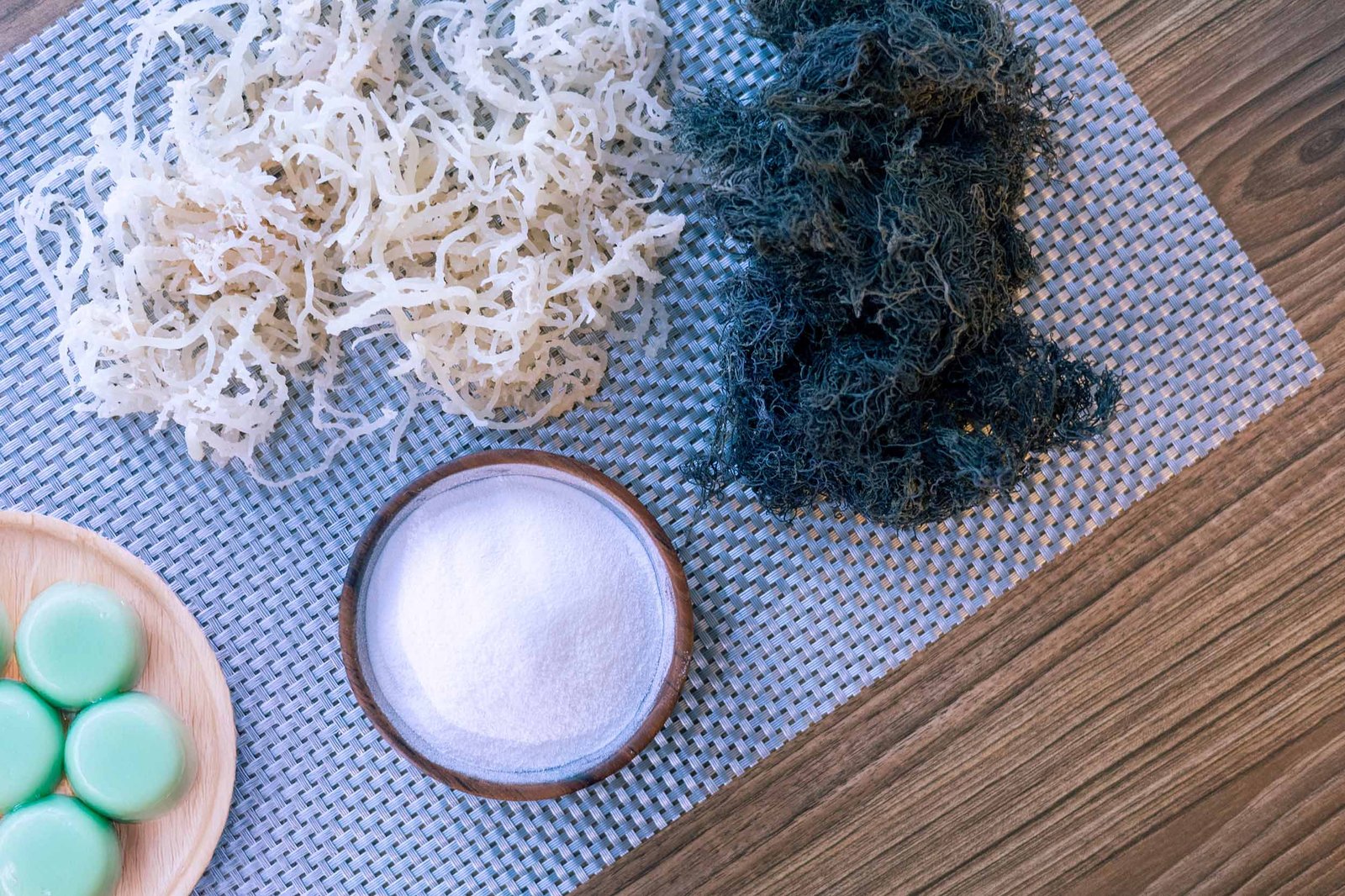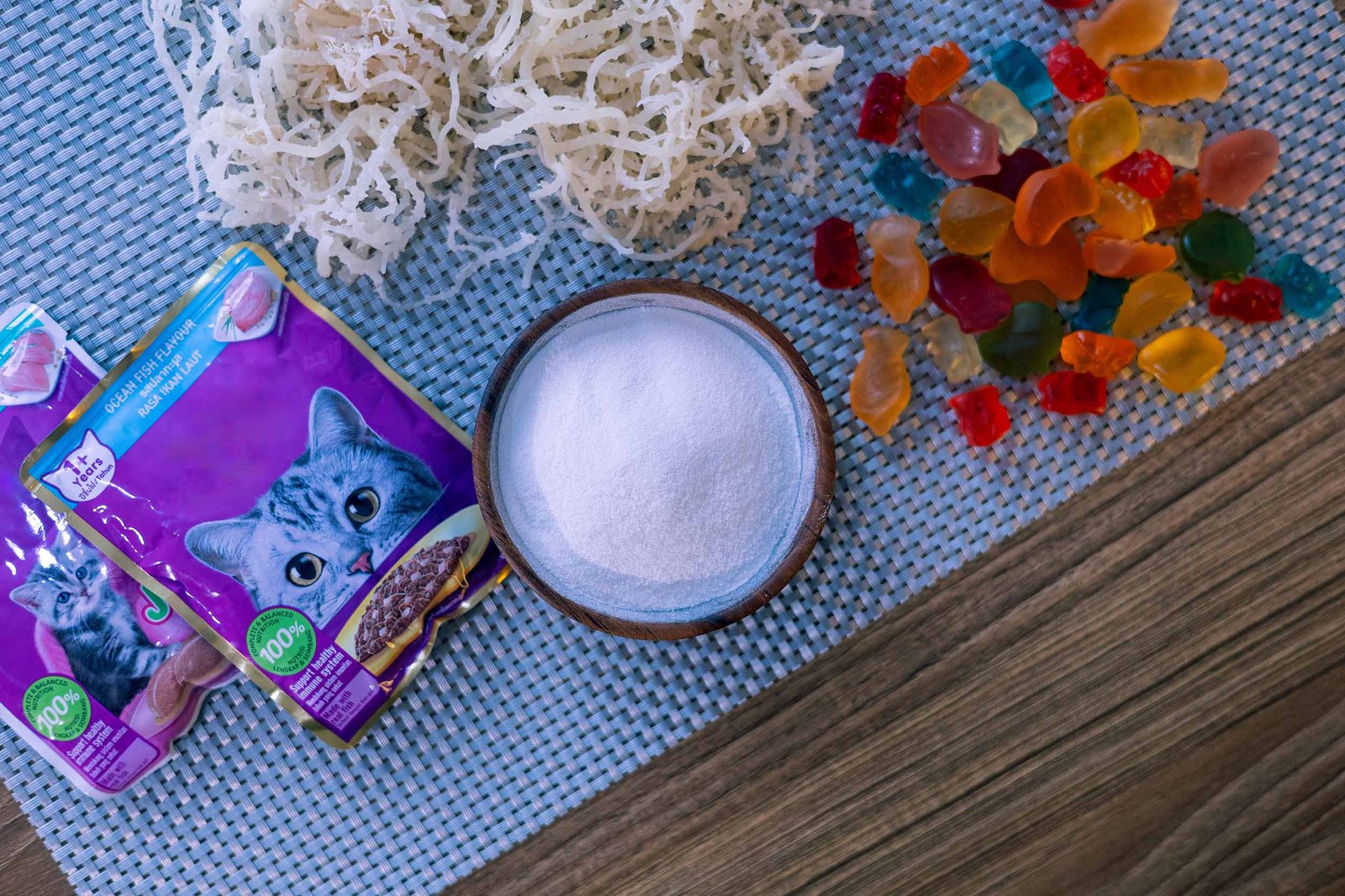
Choosing between carrageenan vs gelatin, xanthan gum, guar gum and konjac is rarely about which one is “better”. It is about which mechanism fits your matrix: a set gel or a pourable sauce, a dairy dessert or a brine-injected ham, a halal or vegan label or a conventional one. This guide compares the five hydrocolloids on the properties R&D teams actually test, and shows where seaweed-derived carrageenan and agar from Bospres hydrocolloids fit in.
- Gelatin gives a melt-in-the-mouth gel because it melts at body temperature, but it is animal-derived.
- Carrageenan is a seaweed-based gelling agent: kappa gives firm gels with potassium, iota gives soft, elastic gels with calcium, lambda only thickens.
- Xanthan and guar are thickeners, not gelling agents on their own.
- Konjac is most valuable as a synergist that makes kappa carrageenan gels more elastic.
How each hydrocolloid builds texture
Before settling carrageenan vs gelatin, look at how each option works. All five ingredients bind water, but they do it in different ways. Understanding the mechanism first saves weeks of trial-and-error at the bench.
Carrageenan: ion-dependent seaweed gels
Carrageenan is a sulfated galactan extracted from red seaweeds. The US regulation 21 CFR 172.620 describes it as a refined hydrocolloid prepared by aqueous extraction from species including Eucheuma cottonii and Eucheuma spinosum, with 20–40% sulfate on a dry basis, permitted as an emulsifier, stabilizer or thickener. The three commercial types behave very differently, as summarised by the FAO technical review of carrageenan:
- Kappa forms a strong, rigid gel with potassium and a brittle gel with calcium. It shows some syneresis (weeping) on its own.
- Iota forms soft, elastic gels with calcium that are virtually free of syneresis and freeze/thaw stable.
- Lambda does not gel; it gives high-viscosity solutions.
Kappa and iota must be heated above 60 °C to dissolve, then gel as the solution cools. FAO notes that as little as 0.5% kappa in water, or 0.2% in milk, is enough to form a gel. In milk, carrageenan reacts with casein, so dairy applications often need only 0.01–0.05%. For a deeper look at the three fractions, see our guide to kappa, iota and lambda carrageenan.
Gelatin: a protein gel that melts in the mouth
Gelatin is a protein made from collagen. A peer-reviewed review in Food Chemistry: X notes that it is obtained from the bones and skins of animals such as fish, cows and pigs. Its signature advantage is sensory: gelatin manufacturer GELITA points out that, unlike agar or pectin, gelatin melts at body temperature, and that its gels are thermo-reversible with adjustable strength through concentration and Bloom.
In any carrageenan vs gelatin decision, that same low melting point is a limitation in warm climates, in shelf-stable desserts and in products that must survive transport without a cold chain. Its animal origin also excludes it from vegan and vegetarian claims and makes halal and kosher status depend on the source species and certification.
Xanthan gum: a shear-thinning thickener
Xanthan is produced by fermentation with Xanthomonas campestris and is regulated in the US under 21 CFR 172.695 as a stabilizer, emulsifier, thickener and suspending agent. The USDA technical report on xanthan gum describes its solutions as highly pseudoplastic: they thin when pumped or poured and recover viscosity at rest. It is stable over a wide range of pH and temperature, tolerates salt and is typically used at 0.05–0.5%.
Gelling is not one of xanthan’s main functions. It builds a gel only in combination with galactomannans such as locust bean gum, or with konjac. That makes it ideal for dressings, sauces and suspensions, but not a substitute for a sliceable or spoonable set gel.
Guar gum: a seed-based thickener
Guar gum comes from the seed of Cyamopsis tetragonoloba and is affirmed as GRAS under 21 CFR 184.1339, mainly as a stabilizer and thickener. That regulation sets maximum use levels by category, for example 0.35% in baked goods and 0.5% in most other food categories. Like xanthan, guar does not form a gel by itself; with xanthan it raises viscosity synergistically rather than setting.
Konjac glucomannan: the elasticity booster
Konjac (E 425) is most useful in combination. A 2025 review in Gels reports that blending konjac glucomannan with kappa carrageenan synergistically enhances gel strength, elasticity and thermal stability, turning brittle gels into coherent, pleasant-textured ones. FAO adds that konjac can replace locust bean gum in kappa systems and gives clearer gels.
There is a regulatory caution for exporters. According to the EFSA 2017 re-evaluation of konjac, EU rules prohibit E 425 in jelly mini-cups and jelly confectionery because of choking accidents. If your product is a cup jelly bound for Europe, carrageenan- or agar-based systems are the safer formulation route.
Carrageenan vs gelatin, xanthan, guar and konjac: comparison table
| Property | Carrageenan (kappa / iota) | Gelatin | Xanthan gum | Guar gum | Konjac |
|---|---|---|---|---|---|
| Source | Red seaweed | Animal collagen (pig, cow, fish) | Bacterial fermentation | Guar seed | Konjac tuber |
| Gels on its own? | Yes (kappa with K⁺, iota with Ca²⁺) | Yes | No | No | Mainly used with kappa or xanthan |
| Gel texture | Kappa firm/brittle; iota soft/elastic | Elastic, melt-in-mouth | Shear-thinning viscosity | Viscosity | Adds elasticity to kappa gels |
| Syneresis | Some (kappa); virtually none (iota) | Depends on formulation | Not applicable (no gel) | Not applicable (no gel) | Reduces brittleness in kappa blends |
| Thermal behaviour | Dissolve above 60 °C, gel on cooling | Melts at body temperature | Stable over wide temperature range | Thickens without a set | Raises thermal stability of kappa blends |
| pH / salt tolerance | Ion-sensitive; acid stability is a formulation check | Varies with Bloom and source | Wide pH; salt-tolerant | Thickener only; test in target matrix | Used with carrageenan or xanthan |
| Vegan / halal-friendly origin | Plant (seaweed) | No (animal); halal depends on source | Yes (fermentation) | Yes (plant) | Yes (plant) |
| Typical use level | 0.01–0.05% in dairy; ~0.5% water gels | Set by Bloom and target firmness | 0.05–0.5% | Up to 0.5% (most US categories) | Low levels in blends |
| Ideal applications | Dairy desserts, jellies, processed meat, pet food | Gummies, mousses, chilled desserts | Dressings, sauces, suspensions | Bakery, cereals, sauces | Jellies with kappa, vegan textures |
Which hydrocolloid should you choose?
Replacing gelatin in vegan or halal products
When a carrageenan vs gelatin swap is driven by a plant-based dessert, gummy or jelly brief, carrageenan and agar are the two seaweed workhorses. Iota carrageenan comes closest to gelatin’s soft elasticity, while kappa gives a firmer, cleaner bite. A kappa–iota or kappa–konjac blend lets you tune between the two. Expect a different melt: seaweed gels do not melt at body temperature the way gelatin does, so sensory panels should judge mouthfeel rather than melt-away alone. For firm, heat-stable gels, compare options in our agar powder GS800 vs GS900 vs GS1000 guide.
Dairy: suspension and creaminess
Because carrageenan reacts with casein, very low doses stabilise milk drinks and desserts. FAO reports kappa at 0.01–0.04% preventing whey separation in cottage cheese and ice cream. Xanthan or guar alone cannot build that protein network, which is why carrageenan suits milk-based drinks and desserts, either alone or in ready-made dairy blends such as FM 46.
Processed meat and pet food
In injected and emulsified meats, kappa carrageenan forms a gel as the product cools, helping hold added water; konjac or locust bean gum blends make that gel less brittle. For pet food loaves, Bospres offers a dedicated SRC Kappa (Pet Food) grade. See our guide to carrageenan for meatballs, fish balls and sausages and the Artagum BA 53 meat blend.

Sauces, dressings and beverages
Where you need pourable viscosity and particle suspension rather than a set gel, xanthan and guar lead. Carrageenan still plays a role when a light gel network is needed, for example in cocoa milk drinks. Our beverage and dessert blends such as Cappiogum BA 45 are designed for these systems.
Regulatory and safety status at a glance
- Carrageenan (E 407) and processed Eucheuma seaweed (E 407a): the EFSA 2018 re-evaluation kept a group ADI of 75 mg/kg bw per day, classed as temporary pending further data, and found no concern for genotoxicity or carcinogenicity. EFSA also repeated that its use in infant formula fed from birth remains inadvisable.
- Xanthan: permitted in the US under 21 CFR 172.695 under good manufacturing practice.
- Guar: GRAS in the US with category-specific maximum levels.
- Konjac (E 425): no safety concern at reported uses per EFSA, but banned in EU jelly mini-cups and jelly confectionery.
- Gelatin: a food ingredient rather than an additive; religious and dietary status depends on its animal source.
Semi-refined vs refined carrageenan: which grade?
FAO explains that the main difference is cellulose: semi-refined carrageenan (labelled processed Eucheuma seaweed, E 407a) retains the seaweed cellulose and gives a cloudy solution, while refined carrageenan (E 407) gives a clear one. Choose refined grades such as RC Kappa for clear jellies and dairy; choose semi-refined grades such as SRC Kappa or SRC Iota where opacity is acceptable and cost-in-use matters. Read more in SRC vs RC carrageenan.
Sourcing carrageenan and agar from Bospres

Bospres sources seaweed directly from Indonesia’s prime seaweed-growing regions and supplies the full seaweed hydrocolloid range:
- Refined and semi-refined carrageenan: RC Kappa, SRC Kappa and SRC Iota.
- Agar powder: GS700, GS800, GS900 and GS1000.
- Custom blends: Artagum, Secagum (for example Secagum BA 31 for cheese) and Cappiogum, tailored to your gel strength and application.
- Buyer-friendly terms: a 550 kg MOQ, quality documentation on our certificates page, and free evaluation samples for R&D teams.
Ready to test carrageenan vs gelatin, xanthan or guar in your own system? Request a free sample or a technical spec sheet and tell us your application, target texture and pH; our team will recommend a grade or blend to test.
Frequently asked questions
Carrageenan vs gelatin: is carrageenan a good substitute?
Yes, for many applications. Iota carrageenan forms soft, elastic gels with calcium and kappa carrageenan forms firm gels with potassium, so a kappa–iota or kappa–konjac blend can approximate gelatin textures in plant-based desserts and jellies. The main difference is melt: gelatin melts at body temperature, while carrageenan gels are more heat-stable, so mouthfeel should be re-evaluated in sensory tests.
Can xanthan gum replace carrageenan?
Not as a gelling agent. Xanthan is a shear-thinning thickener that is stable across a wide pH range and tolerates salt, but it does not gel on its own. It only forms gels in combination with galactomannans such as locust bean gum, or with konjac. In dairy, carrageenan’s reaction with milk casein gives stabilisation at very low doses that xanthan cannot replicate.
What is the difference between kappa and iota carrageenan?
Kappa carrageenan forms strong, rigid gels with potassium salts and can show some syneresis. Iota carrageenan forms soft, elastic gels with calcium salts that are virtually free of syneresis and are freeze/thaw stable. Lambda carrageenan does not gel and is used for viscosity.
Is carrageenan safe to use in food?
Carrageenan (E 407) and processed Eucheuma seaweed (E 407a) are permitted food additives in the EU and the US. EFSA’s 2018 re-evaluation kept a group ADI of 75 mg/kg body weight per day as a temporary value pending further data, and found no concern for genotoxicity or carcinogenicity. EFSA considers its use in infant formula fed from birth inadvisable.