
By Anggit Dimas Anggoro, Director of Sales and Marketing, PT Bospres Global Resources
Refined carrageenan (RC) is purified and gives the strongest, cleanest gels. Semi-refined carrageenan (SRC) is processed more simply and keeps some of the seaweed’s natural cellulose, so it costs less and suits applications where a very clear, very strong gel is not required. The right choice depends on your product, your texture target and your budget.
This article compares the two types using the specifications of the grades we supply from Indonesia: RC Kappa, SRC Kappa and SRC Iota.
What is the difference between SRC and RC carrageenan?
Both are made from red seaweed, such as Eucheuma cottonii for kappa carrageenan and Eucheuma spinosum for iota carrageenan. The difference is in how much of the non-carrageenan material is removed.
- Refined carrageenan (RC) is extracted and filtered so that almost all insoluble material is removed. The result is a pale powder with high purity.
- Semi-refined carrageenan (SRC) is washed and treated with alkali but not fully extracted, so part of the seaweed’s insoluble matter stays in the powder.
You can see this directly in the specifications. RC Kappa has an acid-insoluble ash of max 1%, while SRC grades in our range can carry higher insoluble matter. That is why RC is paler and SRC is cream to light brown.
How do the specifications compare?
| Parameter | RC Kappa | SRC Kappa (pet food) | SRC Iota |
|---|---|---|---|
| Color | Yellowish to white | Cream to light brown | Cream to light brown |
| Salt gel strength (g/cm²) | Min 1300 | 445–715 | 75–200 |
| Viscosity | Min 5 cP | Min 5 cP | Min 5 cP |
| pH | 8.0–11.0 | 8.0–11.0 | 8.0–11.0 |
| Particle size | Min 90% through #120 | Min 95% through #40 | Min 95% through #40 |
| Moisture | Max 12% | Max 12% | Max 12% |
| Packaging | 25 kg, 2 years shelf life | ||
The biggest gap is gel strength. RC Kappa reaches a salt gel strength of at least 1300 g/cm², roughly twice the top of the SRC Kappa pet food range. For SRC Iota the gel is deliberately soft and elastic.
When should I choose refined carrageenan?
Choose RC when you need a firm, stable gel, when color or clarity matters, or when the final product is sold on texture. RC Kappa has fine particles (min 90% through #120 mesh), so it disperses quickly and suits general food and non-food applications that need a firm gel.
When should I choose semi-refined carrageenan?
Choose SRC when a lower cost per kilogram matters and the product does not need the cleanest gel. Pet food is the classic example. A wet pet food loaf or chunk needs a stable gel, but not the color or clarity of a dessert.
- SRC Kappa for pet food has a salt gel strength of 445–715 g/cm². It forms a firm gel that supports loaf and chunk textures.
- SRC Iota forms a soft, elastic gel that reduces syneresis and improves juiciness.
- SRC Kappa for brewery use works as a clarifying agent for beer and wort, with a salt gel strength of 300–400 g/cm².
How are SRC and RC made?
The steps are similar at the start. Dried seaweed is washed to remove salt, sand and other impurities, then treated with alkali, which improves gel strength. After that the routes split.
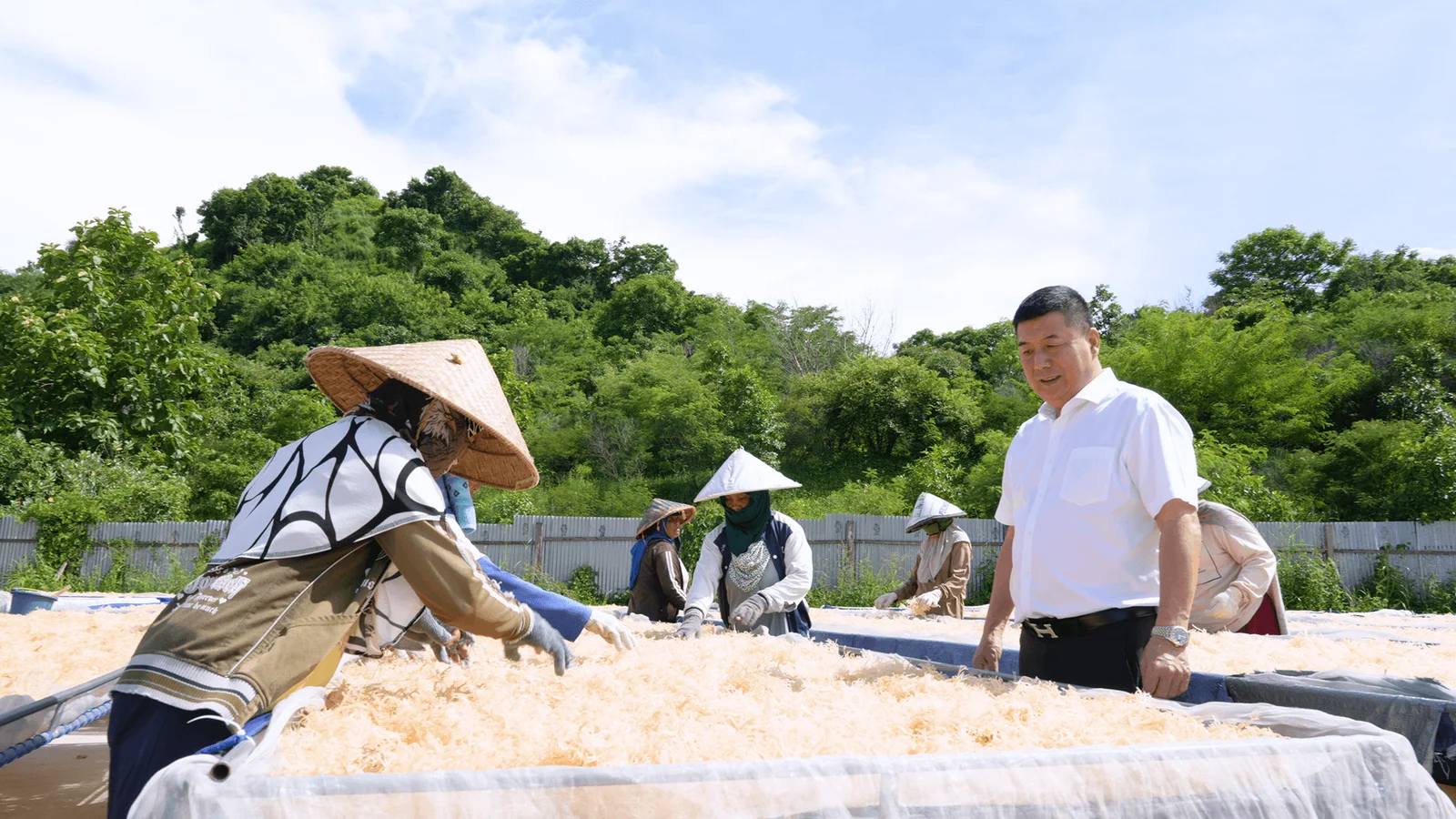
For SRC, the treated seaweed is washed again, dried and milled. The carrageenan is never dissolved out of the seaweed, so the cellulose stays in the powder. This is simpler and gives a higher yield per kilogram of seaweed, which is why SRC costs less.
For RC, the carrageenan is extracted in hot water, the insoluble cellulose is filtered out, and the clear solution is concentrated, precipitated, dried and milled. The extra steps raise cost, but they give a purer powder with a stronger and cleaner gel.
This is also why the starting material matters. Alkali-treated cottonii (ATC) is an intermediate that already went through the alkali step, and processors use it as a starting point for kappa carrageenan.
What is the difference between kappa and iota carrageenan?
Kappa carrageenan forms firm, brittle gels and reacts strongly with potassium. Iota carrageenan forms soft, elastic gels and reacts with calcium. Our figures show the gap: SRC Kappa for pet food has a salt gel strength of 445–715 g/cm², while SRC Iota is 75–200 g/cm². Many recipes combine both to tune texture.
Is SRC or RC safer to use in food?
Both are food-additive carrageenan (E407) and both are tested against safety limits. RC Kappa, for example, has limits of max 1 mg/kg mercury, max 1 mg/kg cadmium, max 3 mg/kg arsenic and max 5 mg/kg lead, with a total plate count of max 5,000 cfu/g and Salmonella negative in 25 g. Always check the certificate of analysis for the lot you receive and compare it with your own limits and local regulation.
How do I decide between SRC and RC for my product?
- Define the texture. Firm and sliceable, soft and elastic, or just a clarifying effect?
- Check color and clarity needs. A pale, clean powder points to RC.
- Calculate cost in use. A higher gel strength can mean a lower dosage, so compare cost per finished kilogram.
- Run a side-by-side trial at the same dosage in your own recipe.
If your product is a blend of several ingredients, a ready-made blend may save development time. See our custom blended carrageenan range, which has recommended dosages for each application.
What should I know about supply and ordering?
- Minimum order: 550 kg (1 CBM), packed in 25 kg bags. If you need a custom formulation to your own recipe, the minimum order is 25 tons.
- Lead time: 14 days after deposit.
- Shipping: CIF, FOB or other Incoterms by agreement, from Tanjung Priok or Tanjung Perak.
- Samples: free, with shipping paid by the buyer. Sample size can be adjusted to your request.
- Documents: certificate of analysis with every lot, commercial invoice and packing list.
HS code for carrageenan is 1302.39. Please confirm the code with your customs broker, because rules differ by country.
Not sure whether RC or SRC fits your product? Contact our team with your application and target texture, and we will recommend a grade and send a free sample. You can also browse the full carrageenan range.
About the author: Anggit Dimas Anggoro is the Director of Sales and Marketing of PT Bospres Global Resources, which supplies agar, carrageenan and dried seaweed from Indonesia under the Bospres Hydrocolloids brand. He works directly with buyers on specifications, samples and export documents.
Semi-refined: what buyers should know
Bospres Global Resources supplies seaweed hydrocolloids to food, feed and industrial buyers worldwide. Our guidance on semi-refined comes from daily export work: every shipment is graded, tested and documented before it leaves Jakarta.
Semi-refined specifications and samples
Ask our sales team for the technical data sheet, certificate of analysis and a free sample. We confirm grade, moisture, packaging and delivery schedule in writing, and we can match the product to your recipe or process requirements. Semi-refined grades differ by gel strength, viscosity and clarity, so we match semi-refined to your application.
To order semi-refined, send us the grade, volume and destination port through the quote form. Our team replies within one business day with price, lead time and shipping options.
Request a quoteFurther reading: carrageenan overview and FAO seaweed resources.