
By Anggit Dimas Anggoro, Director of Sales and Marketing, PT Bospres Global Resources
Kappa carrageenan forms firm, brittle gels, iota carrageenan forms soft, elastic gels, and lambda carrageenan does not gel at all but thickens. The difference comes from the number of sulphate groups on the carrageenan chain: one for kappa, two for iota and three for lambda.
This guide explains how the three types behave, which seaweed each one comes from, and which grades we supply from Indonesia.
What are kappa, iota and lambda carrageenan?
Carrageenan is a family of polysaccharides extracted from red seaweed. All of them are used as gelling, thickening and stabilizing agents in food, pet food, personal care and technical products. They are grouped by the amount and position of sulphate groups, and that structure decides how they behave in water.
| Kappa | Iota | Lambda | |
|---|---|---|---|
| Gel type | Firm, brittle | Soft, elastic | No gel; thickener |
| Reacts with | Potassium | Calcium | No gelling ions needed |
| Syneresis (water release) | Present | Low | Not applicable |
| Typical seaweed | Eucheuma cottonii (Kappaphycus alvarezii) | Eucheuma spinosum (Eucheuma denticulatum) | Gigartina and related species |
What is kappa carrageenan used for?
Kappa carrageenan gives the strongest gel of the three. It suits products that need a firm, sliceable structure, such as processed meat, jellies and wet pet food loaves. It works well with potassium salts and with milk proteins.
In our range, RC Kappa is a refined grade with a salt gel strength of min 1300 g/cm². SRC Kappa for pet food has a salt gel strength of 445–715 g/cm² and forms a firm gel for loaf and chunk textures. A related grade, SRC Kappa for brewery use, works as a clarifying agent for beer and wort.
What is iota carrageenan used for?
Iota carrageenan makes soft, elastic gels that hold water well and release little of it. It reacts with calcium, and the gel can recover its shape after being cut or stirred.
SRC Iota has a salt gel strength of 75–200 g/cm². In pet food it gives an elastic texture, reduces syneresis and improves juiciness. Because it forms a firm gel with calcium ions, you can tune it with the calcium level in the recipe.
What is lambda carrageenan used for?
Lambda carrageenan does not form a gel. It dissolves in cold water and gives viscosity, so it is used to thicken drinks, sauces and dairy products. We do not currently list a lambda grade in our standard range. If you need one, contact our team and describe your application.
Can I blend kappa and iota carrageenan?
Yes. Blending is common, because each type fixes a weakness of the other. Kappa adds firmness, while iota adds elasticity and reduces water release. The ratio, plus the salts and other hydrocolloids in the recipe, sets the final texture.
For ready-made solutions, see our custom blended carrageenan range. Each blend lists its viscosity, gel strength and recommended dosage for a specific application, such as meatballs and rollade, condensed milk or ice cream.
Which seaweed does each carrageenan type come from?
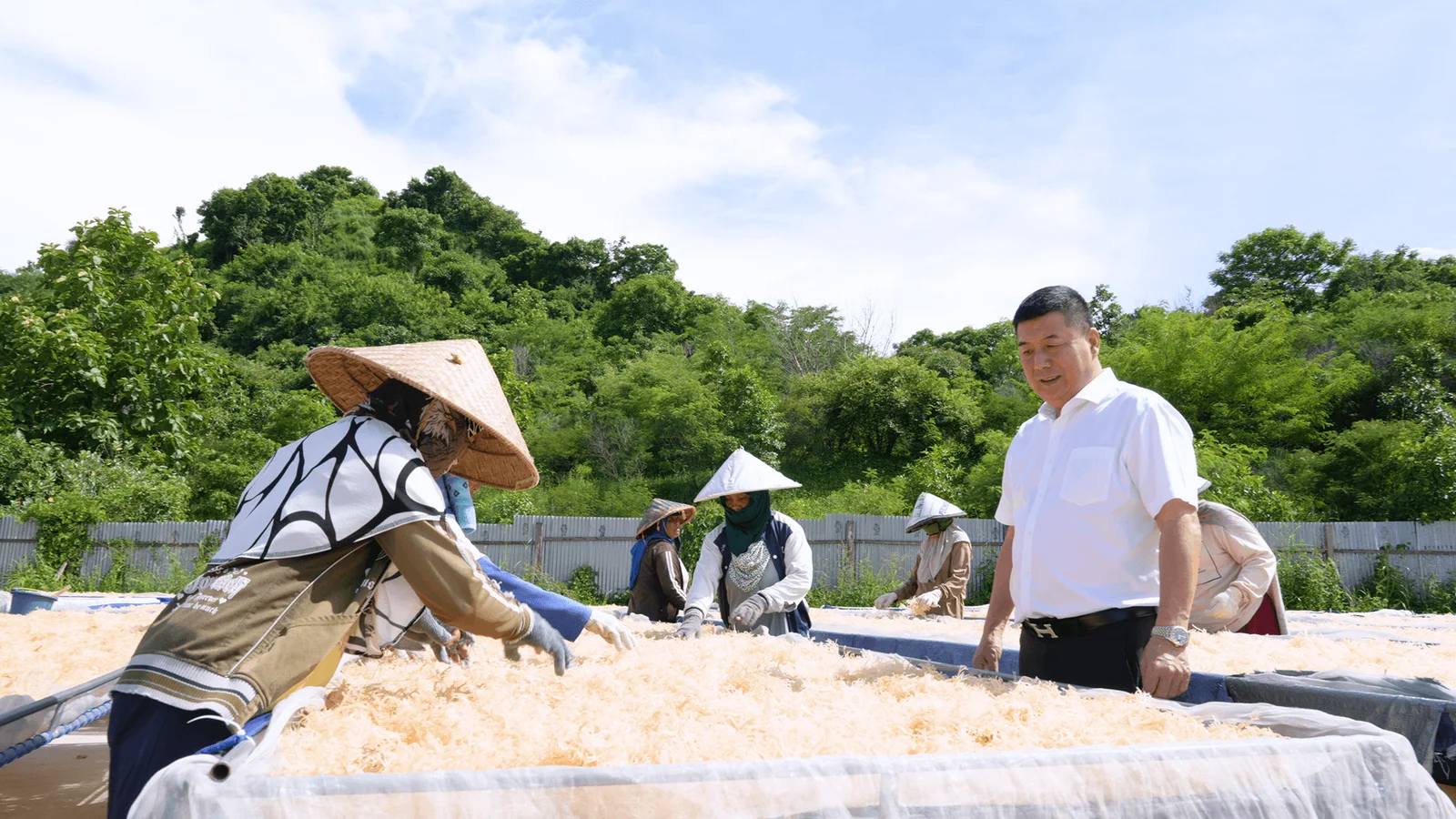
Kappa carrageenan is extracted mainly from Eucheuma cottonii, and iota from Eucheuma spinosum. Both are cultivated in Indonesia, and both are traded as dried seaweed. See our pages for dried Eucheuma cottonii and dried Eucheuma spinosum.
Processors can also start from alkali-treated cottonii (ATC) for kappa and alkali-treated spinosum (ATS) for iota. These are intermediates that already went through the alkali step.
How do I choose the right carrageenan type?
- Define the texture: firm and sliceable (kappa), soft and elastic (iota), or just thicker (lambda).
- Check the salts in your recipe. Potassium favours kappa, and calcium favours iota.
- Decide on refined or semi-refined. Refined gives a paler, stronger gel. Semi-refined costs less and suits applications such as pet food. Our SRC vs RC comparison explains the difference.
- Test two grades side by side at the same dosage.
How do carrageenan types behave when heated and cooled?
All carrageenan types need heat to dissolve fully. Our blends dissolve in water above 60 °C and thicken as the solution cools. Kappa and iota then form their gel during cooling, and the gel sets at a temperature that depends on the salts present.
Three practical points help in production:
- Disperse first. Mix the powder with sugar or another dry ingredient before adding it to the liquid, so it does not form lumps.
- Heat enough. Hold the solution at the dissolving temperature until it is clear or uniform, because undissolved particles weaken the gel.
- Control the salts. Potassium strengthens kappa gels, and calcium strengthens iota gels. Too much salt can make a gel brittle, so adjust gradually.
What mistakes do buyers make when choosing a carrageenan type?
The most common mistake is asking for “carrageenan” without saying which type. A kappa grade used where iota was intended gives a brittle gel that releases water, and an iota grade used where kappa was intended gives a gel that is too soft to slice.
The second mistake is comparing gel strength numbers without checking the method. Our figures are salt gel strength in g/cm², and a figure from another method is not directly comparable. Ask the supplier how the number was measured.
The third is skipping a trial. A small side-by-side test in your own recipe costs little and avoids an expensive production mistake. Free samples make this easy.
What should I know about supply and ordering?
- Minimum order: 550 kg (1 CBM), packed in 25 kg bags. If you need a custom formulation to your own recipe, the minimum order is 25 tons.
- Lead time: 14 days after deposit.
- Shipping: CIF, FOB or other Incoterms by agreement, from Tanjung Priok or Tanjung Perak.
- Samples: free, with shipping paid by the buyer. Sample size can be adjusted to your request.
- Documents: certificate of analysis with every lot, commercial invoice and packing list.
HS code for carrageenan is 1302.39. Please confirm the code with your customs broker, because rules differ by country.
Not sure which type fits your product? Contact our team with your application and target texture, and we will recommend a grade and send a free sample.
About the author: Anggit Dimas Anggoro is the Director of Sales and Marketing of PT Bospres Global Resources, which supplies agar, carrageenan and dried seaweed from Indonesia under the Bospres Hydrocolloids brand. He works directly with buyers on specifications, samples and export documents.
Lambda carrageenan: what buyers should know
Bospres Global Resources supplies seaweed hydrocolloids to food, feed and industrial buyers worldwide. Our guidance on lambda carrageenan comes from daily export work: every shipment is graded, tested and documented before it leaves Jakarta.
Lambda carrageenan specifications and samples
Ask our sales team for the technical data sheet, certificate of analysis and a free sample. We confirm grade, moisture, packaging and delivery schedule in writing, and we can match the product to your recipe or process requirements. Lambda carrageenan grades differ by gel strength, viscosity and clarity, so we match lambda carrageenan to your application.
To order lambda carrageenan, send us the grade, volume and destination port through the quote form. Our team replies within one business day with price, lead time and shipping options.
Request a quoteFurther reading: carrageenan overview and FAO seaweed resources.